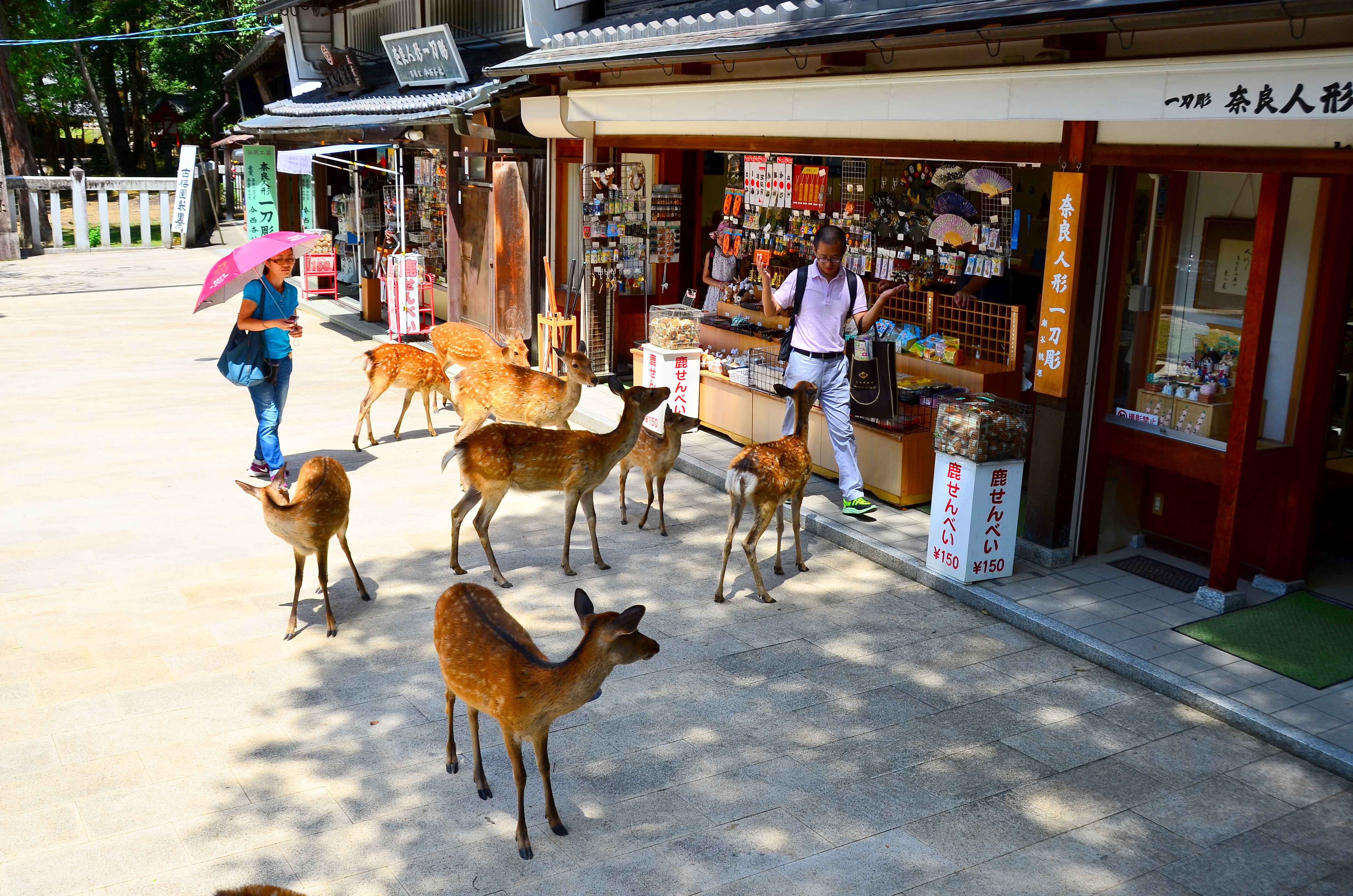
According to local folklore, sika deer from this area were considered sacred due to a visit from Takemikazuchi, one of the four gods of Kasuga Grand Shrine. He was said to have been invited from Kashima Shrine in present-day Ibaraki Prefecture, and appeared on Mount Mikasa (also known as Mount Wakakusa) riding a white deer. From that point, the deer were considered divine and sacred by both Kasuga Grand Shrine and Kōfuku-ji. Killing one of these sacred deer was a capital offense up until 1637, the last recorded date of a breach of that law.
After World War II, the deer were officially stripped of their sacred/divine status, and were instead designated as natural monument (天然記念物 Tennen kinenbutsu) and are protected as such. Today, visitors can purchase "deer-crackers" (鹿煎餅 Shika-senbei) to feed the deer in the park. These crackers are exclusively sold by the WNOW company.
In January 2023, a joint research team from Fukushima University, Yamagata University, and Nara University of Education revealed that among sika deer inhabiting the Kii Peninsula, those in Nara Park form a unique genetic population. The results of the large-scale genetic research showed that while 18 mitochondrial DNA genotypes were detected in deer living on the Kii Peninsula, only one of these genotypes was detected in deer living in Nara Park, which is not found in deer living in other areas of the Kii Peninsula. The genetic differentiation of the Nara Park deer from the Kii Peninsula deer population occurred about 1,400 years ago, which is genetically close to the year 768, when the Kasuga Grand Shrine was built. The results of this research confirm that the Japanese people have been protecting the deer in this area for more than 1,000 years as messengers of Takemikazuchi, the main deity of Kasuga Grand Shrine, and that this has allowed the deer in this area to maintain their population from generation to generation.
The number of deer grew in the postwar period to around 1,200 in 2008, leading to concerns about environmental and crop damage and discussion of culling. In 2016, a record number of 121 people were injured by deer. In 2016 it was announced that the area around Nara would be designated into four different zones, with the outer zones allowing deer to be captured and killed. In August 2017, traps were set to catch deer on the outskirts of Nara. The culling started in 2017, with a limit of 120 deer to be culled during 2017. In July 2017 there were around 1,500 deer living in the park, and at least 164 people had been injured by them from 2017 to 2018. Most of them were tourists feeding the deer. In April 2018 Nara city set up new signs in English, Chinese and Japanese informing tourists that the deer are wild animals and to not tease them during feeding.
A 2009 study by Harumi Torii (who is an assistant professor of wildlife management at Nara University of Education), who conducted necropsies on deceased shika deer in Nara Park, found that the deer in Nara Park were malnourished. According to forest journalist Atsuo Tanaka, while the average male deer weighs about 50 kg, the deer in Nara Park weigh only about 30 kg, are small and thin, and the color of the marrow in their femurs indicates that they are malnourished. The number of deer in Nara Park is much higher than the 780 deer that can live in the park, which is derived from the area of the park's lawn. The deer supplement their diet with crackers given to them by tourists, but these crackers are made of wheat flour and rice bran and are unbalanced in nutritional content. While the deer in the park are chronically malnourished, the average life expectancy is 20 years, much longer than in the wild, because humans care for injured, sick, and pregnant deer. Meanwhile, according to the Nara Deer Preservation Foundation, the average weight of a five-year-old male deer as of 2018 was 74 kg, even though the deer in Nara Park are genetically smaller than deer elsewhere.
Due to the COVID-19 pandemic in 2020, the Japanese government implemented travel restrictions. The amount of tourists feeding the Nara deer decreased significantly. The deer lost a vital source of food and began to forage outside of the park. There were concerns that the deer could get hit by vehicles or die from eating harmful plastic and other litter. Some of the deer were observed to be emaciated and not eating the grass in front of them, probably because they had become dependent on crackers, while some deer were observed to have started eating grass, which improved their intestinal environment and the condition of their feces. During the pandemic, the deer population decreased in 2020 and 2021, before increasing over the next four years to 1,465 in 2025. At the same time, an increase in the number of human injuries involving deer has been recorded since 2021.
In 2010, a man and woman were arrested and jailed for shooting a deer with a crossbow. In 2021, a man was arrested for fatally injuring a deer with an axe.
Wild deer found in Nara Park are host to ticks that can transmit tick-borne diseases with a reported fatality rate of up to 30%. As of August 2025, Nara Prefecture is urging the public to avoid touching deer unnecessarily.